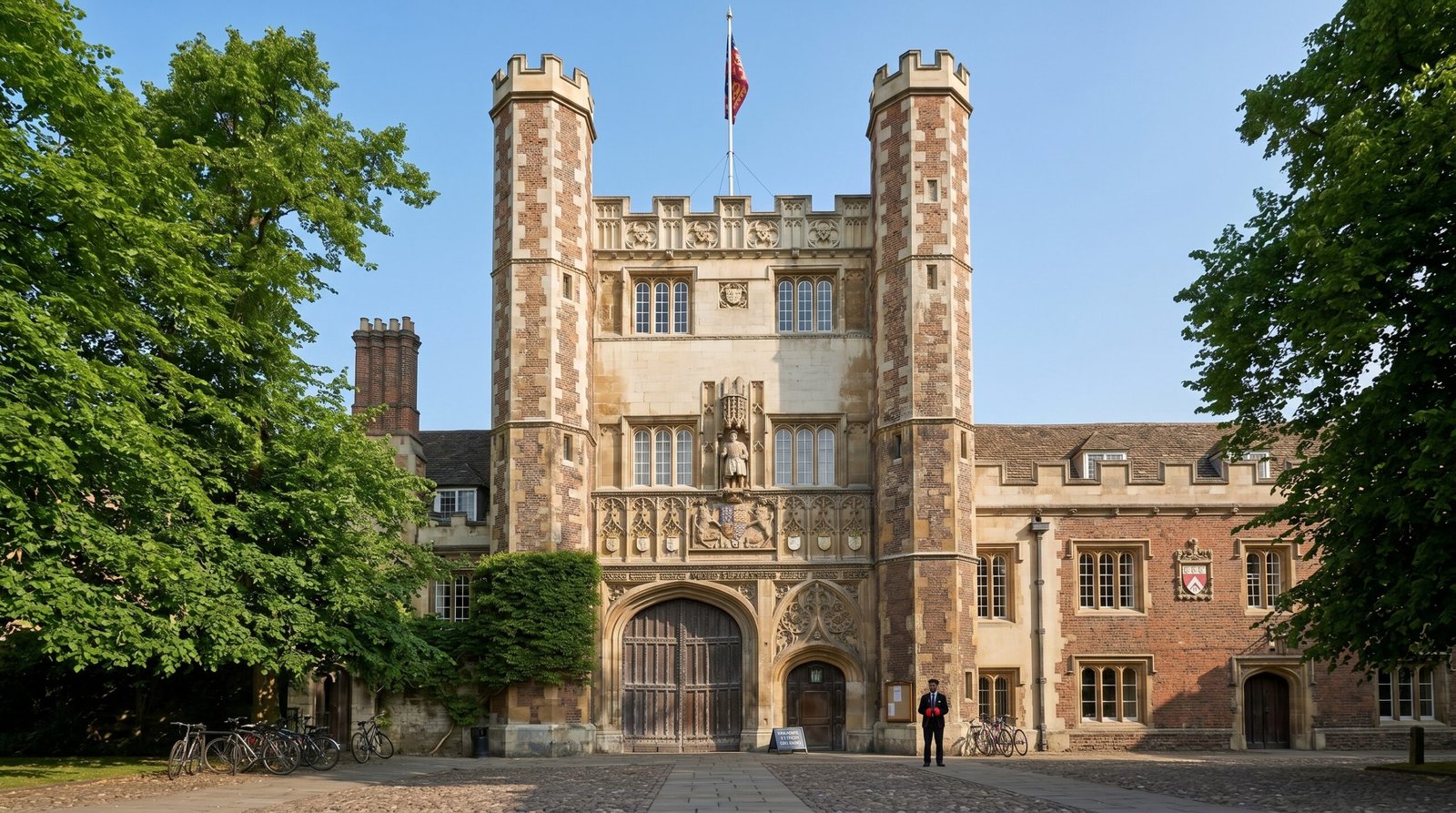
The colleges are designed to be photographed. What sits behind them is what we’re after.
Cambridge is a city built for show. The colleges, the lawns, the punts — they are designed to be photographed. What’s interesting is what sits behind them.
We run a WhatsApp scavenger hunt through Cambridge, which means we spend a lot of time looking up, ducking down side passages, and reading plaques most visitors miss. Here are ten corners of the city that don’t make the postcards — and the stories attached to them.
1. The Round Church
Bridge Street, opposite the entrance to St John’s.
One of only four medieval round churches still standing in England. Built around 1130, it’s about thirty years older than the colleges that grew up around it. The shape isn’t decorative — it was modelled on the Church of the Holy Sepulchre in Jerusalem, brought back by Crusaders who wanted somewhere local that felt like the place Christ was buried. Step inside (small entry fee) and you stand in a perfect circle of Norman stone, the kind of room a Templar might have prayed in. Most tourists walk straight past it on the way to the river.
2. The Mathematical Bridge — and the lie everyone tells
Queens’ College, visible from the Silver Street bridge.
The wooden footbridge crossing the Cam at Queens’ is sometimes called the Mathematical Bridge. The legend, repeated by every tour guide who ever walked the river path: Isaac Newton designed it, it was built without a single nail or bolt, students once took it apart and couldn’t put it back together so they had to add bolts. None of this is true. Newton died in 1727. The bridge was built in 1749. It has always had bolts. The lie persists because it’s a better story than the truth — which is exactly why it’s a perfect Cambridge fact.
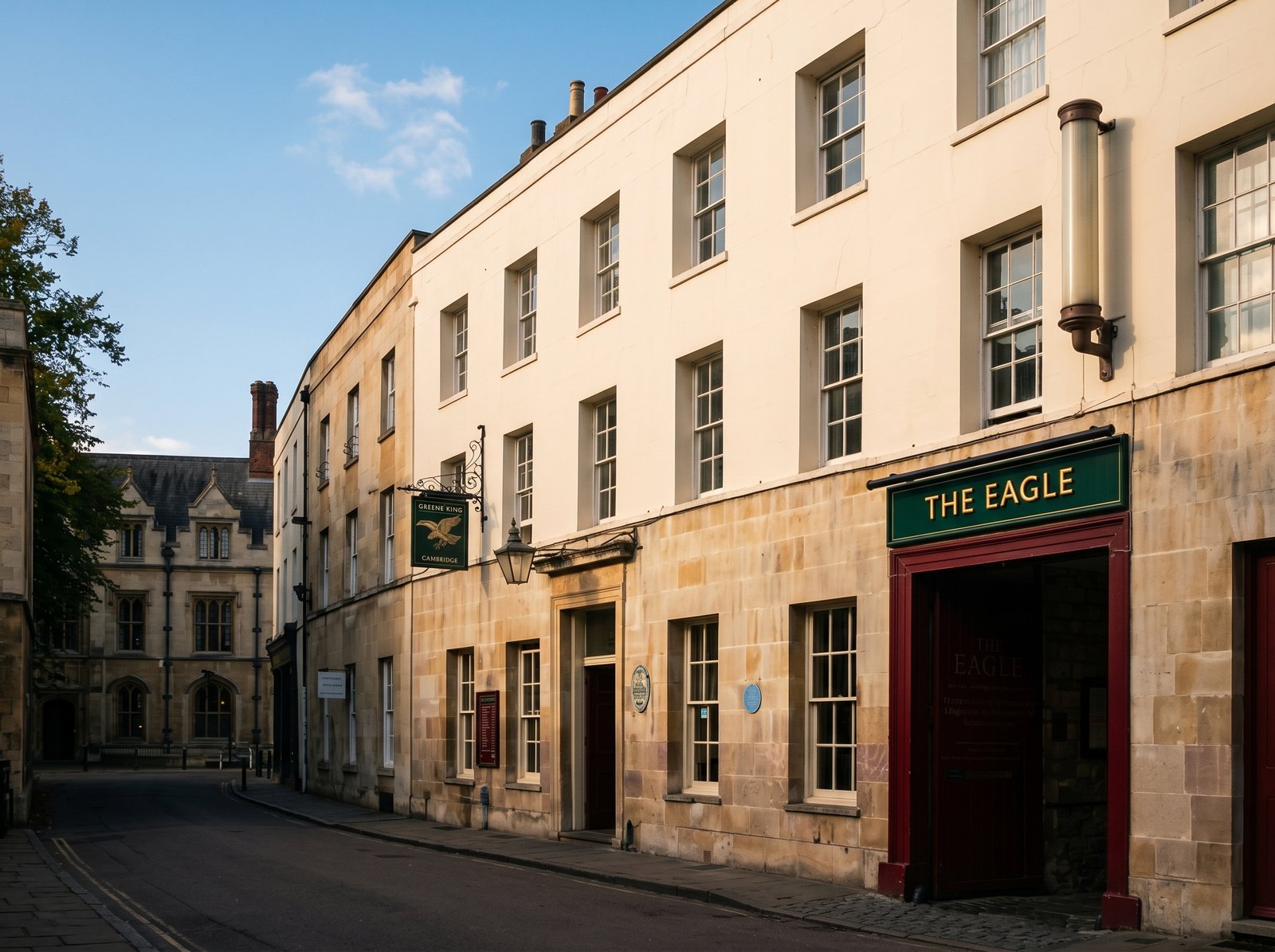
3. The ceiling of the RAF Bar at The Eagle
The Eagle pub, Bene’t Street.
The Eagle is famous as the pub where Francis Crick walked in at lunchtime on 28 February 1953 and announced to a startled lunch crowd that he and Watson had “discovered the secret of life.” DNA, decoded over warm beer. There’s a plaque. But the ceiling of the back room — the RAF Bar — is what’s actually worth seeing. During the Second World War, American and British airmen stationed near Cambridge would climb on shoulders, hold up lighters, and burn their squadron numbers and names into the ceiling. The marks are still there. So is the lipstick from one airman’s wife, kissed onto a beam before he left for a bombing run he didn’t return from.
4. The Apostles’ rooms at Trinity
Trinity College Great Court, visible from inside if you take a tour.
The Cambridge Apostles — a secret intellectual society — met in members’ rooms at Trinity from the 1820s onwards. Most of the membership were brilliant young men who went on to do brilliant respectable things. A handful, between roughly 1930 and 1951, decided to betray their country to the Soviet Union instead. Guy Burgess, Anthony Blunt, Kim Philby, John Cairncross — all Trinity, all Apostles, all spies. Their rooms are still there. Anthony Blunt was the keeper of the King’s pictures for over thirty years before he was publicly named. If you stand in Great Court and look up at the windows, you are looking at the offices where the most effective Soviet penetration of British intelligence in the twentieth century was planned over sherry.
5. Hobson’s Conduit
Trumpington Street, by the entrance to the Botanic Garden.
Thomas Hobson ran a livery stable in Cambridge in the early 1600s. He hired horses to students and academics, but he had a strict rule — you took the horse nearest the door or you got no horse at all. No choice. He also, in 1614, paid for fresh water to be piped down from a spring at Nine Wells, three miles south, into a stone basin in the centre of town. The basin moved in the Victorian period to its current spot by the Botanic Garden. The phrase he gave the English language — “Hobson’s choice” — outlived him by 400 years. Most people walk past the stone basin without realising they are passing a piece of vocabulary.
6. The Wren Library at Trinity
Trinity College, accessible during open hours (free).
Designed by Sir Christopher Wren in the 1680s, the Wren Library holds some of the most extraordinary objects in any university library in the world. Isaac Newton’s notebooks. The original manuscript of A.A. Milne’s Winnie-the-Pooh. A first edition of Shakespeare. Wittgenstein’s working papers. The library is open to the public for a couple of hours a day and is almost always empty. Whisper if you visit.
7. The All Saints’ Garden churchyard
Trinity Street, opposite St John’s College.
For most of the day the All Saints’ Garden hosts an arts and crafts market — local jewellers, painters, ceramicists laying out their stalls. What people don’t always notice is that the garden was a churchyard. All Saints’ Church, which used to stand here, was demolished in 1865 because the road was being widened. The bodies were never moved. Most of the stallholders selling earrings and prints today are standing directly over Cambridge residents who have been buried beneath them for several hundred years. There is no plaque.
8. The Bridge of Sighs at St John’s
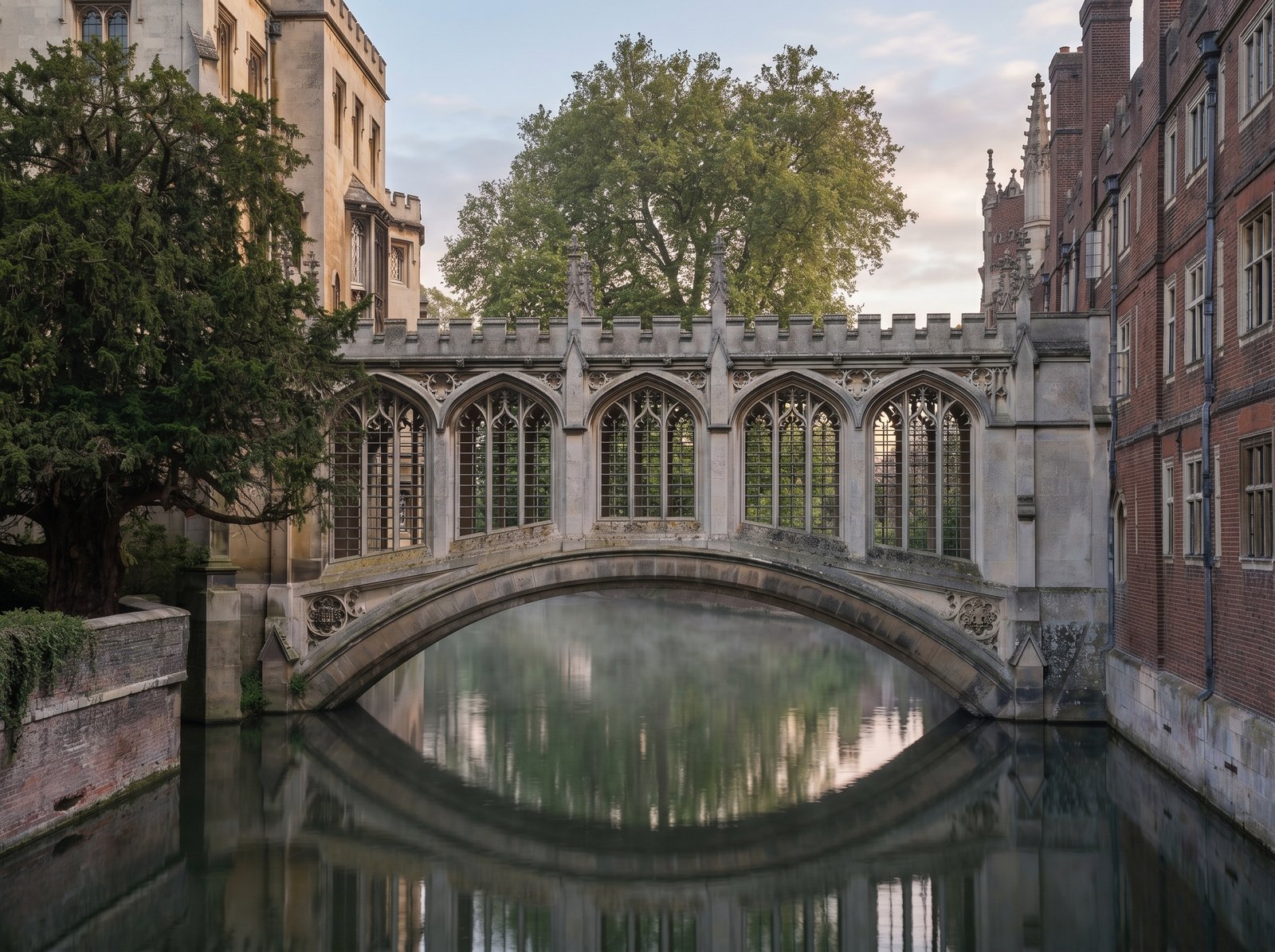
St John’s College, visible from Kitchen Bridge upriver.
Cambridge has a Bridge of Sighs. So does Oxford. So does Venice. They all share a name and almost nothing else. The original in Venice connected the Doge’s Palace to a prison — condemned prisoners sighed as they crossed it. Cambridge’s, built in 1831, connects two parts of St John’s College and was just a covered walkway for students. The name was applied a century later because tourists wanted there to be a story. The bridge itself is beautiful. The fact that the name was invented for tourism is, somehow, also beautiful.
9. The plaque marking the discovery of the electron
Free School Lane, side of the Old Cavendish Laboratory.
Behind a wooden door on Free School Lane, in a Victorian brick building most tourists never enter, J.J. Thomson identified the electron in 1897. The same building saw Ernest Rutherford split the atom in 1932, James Chadwick discover the neutron, and Watson and Crick model DNA in 1953. There is a small plaque on the outside wall. The discoveries inside that building rewrote the twentieth century. The lane it sits on is the kind of place you walk down without noticing because it leads to a café.
10. The market that has been there for 800 years
Market Square, centre of town.
Cambridge market has been trading on the same square, more or less continuously, since at least 1224. A document from Henry III’s reign formally granted the city the right to hold a market here, but the trading was already going on. The university was twelve years old when the market got its first royal charter. The colleges grew up around an existing trading town, not the other way round. The stalls today sell coffee and bao buns and used vinyl. The cobbles beneath them have been worn smooth by 800 years of feet. The square is the oldest continuously-operating thing in the city, and almost no one stops to think about it. They are usually queueing for the doughnut van.
Walk all ten as a Cold War mission
Reading a list is one way to see Cambridge. Following one is another. Our Cambridge Spy Scavenger Hunt sends clues by WhatsApp from a starting point at Market Square. You become a Cold War operative tracking a defector through the city. £20 covers your whole group. No app, no booking slot. 90 to 120 minutes. The route pulls you through bridges, courtyards, alleys and plaques you wouldn’t otherwise notice — including some of the ones above.
The city is older than it looks. Most people walk right past.
Not ready to walk yet?
Get the next set of hidden corners straight to your inbox. Once a month. No spam. Unsubscribe in one click.
Or for Norfolk: 10 hidden corners of Norwich most locals walk past.