
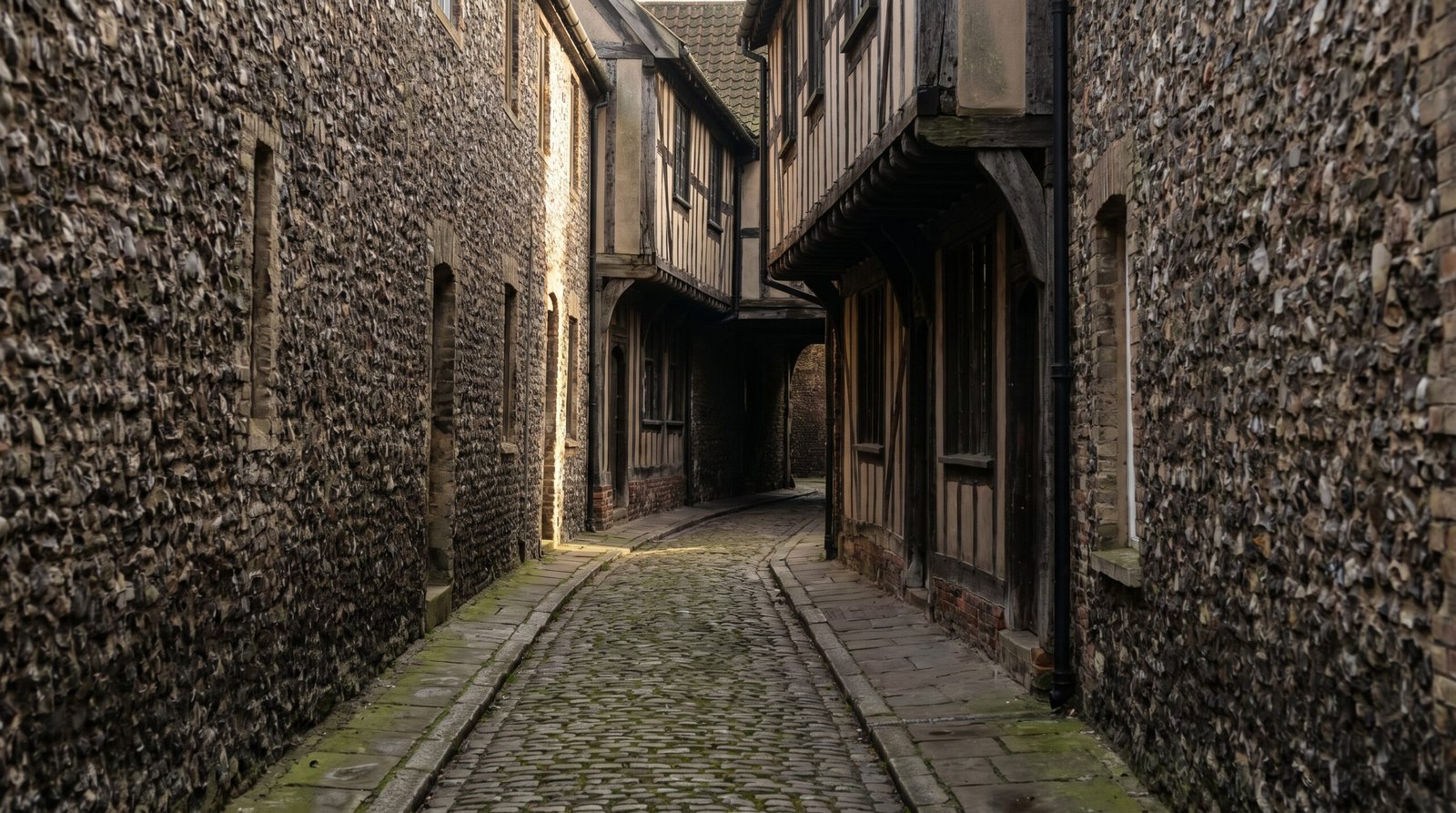
The medieval city’s best secrets aren’t the cathedral or the castle. They’re in the alleys.
Norwich has roughly fifty alleys, courts and lanes between the river and the castle — most of them with at least one story attached. We run a WhatsApp scavenger hunt through Norwich, so we spend more time in them than is strictly healthy. Here are ten corners that most people walk past without noticing. None of them require a ticket. All of them reward a slow look.
1. Tombland Alley
Off Tombland, behind the Augustine Steward House.
The name has nothing to do with tombs — it comes from two Old English words meaning “empty space,” because this was the Saxon market before the Normans built the castle. The alley does, however, have a ghost story. In 1578 Norwich was hit by plague; the residents of the Augustine Steward House were sealed inside, and one young girl — still alive — is said to have been left to starve. Her ghost is reportedly seen walking the alley, “her legs fading away below the knees.” The Augustine Steward House is at the back. Best at dusk.
2. The Bridewell flint nipple
In the wall between Bridewell Alley and St Andrews Hill.
The Bridewell — now the Museum of Norwich — sits behind one of the finest flint-knapped walls in England. Flint knapping is the art of shaping rough flint into perfect squares so a wall can be built without visible mortar. The Bridewell wall has been there since around 1403. Hidden among the lumps and bumps is a single flint shaped like a nipple. Locals sometimes touch it for luck. It’s not signed. You have to look for it.
3. Plumbers Arms Alley
Between Hungate and Princes Street.
In 1414 this alley was officially recorded as a public right of way granted to one Ralph Gunton — and described in the same record as a place where malefactors lay in wait by night “to commit ambushes.” It was so notorious that the city had it sealed off for several years to stop the muggings. Six hundred years later it is still narrow, still atmospheric, still slightly suspect after dark. Bring a friend.
4. The Briton’s Arms
51 Elm Hill. You can’t miss it. But people do.
In 1507 a fire ripped through Elm Hill and burned more than seven hundred Norwich buildings in a single afternoon. One survived. The Briton’s Arms — a three-storey thatched medieval building from 1347 — is still standing, with every neighbour rebuilt around it. It became an alehouse in 1760 and is now a restaurant with a rooftop garden. The fact that it shouldn’t, by rights, exist at all is the most interesting thing about it.
5. The Maddermarket’s Sistine Chapel ceiling
St John’s Alley.
The Maddermarket Theatre is a 300-seat community theatre tucked into the Lanes. It opened in 1921 in a converted former chapel. The vaulted ceiling above the auditorium was modelled on the Sistine Chapel’s vaulting — in Norwich, in a small theatre, hidden behind a black-painted exterior most people walk past on the way to a pub. Look up next time you’re inside.
6. St Julian’s anchorage cell
St Julian’s Church, Rouen Road.
Around 1373 a woman known to history as Julian of Norwich was walled into a small cell attached to a church on what is now Rouen Road. She lived there for the next forty-odd years. While she was inside, she wrote Revelations of Divine Love — generally considered the earliest surviving book in English written by a woman. The line everyone knows from her work — “all shall be well, and all manner of thing shall be well” — was written from inside that cell. The current church is a 1953 reconstruction of the original (which the Luftwaffe destroyed in 1942), but the cell is faithfully placed and you can still walk into it.
7. Pulls Ferry
Cathedral Close, by the river.
The Norman builders of Norwich Cathedral imported the white stone for it from Caen in Normandy — by ship to Yarmouth, then up the Wensum. Pulls Ferry is the small flint archway through which the stone barges were towed, up a now-disappeared canal, directly to the building site. The canal is gone. The arch is still there, photogenic, unsigned, mostly ignored by everyone walking the river path.
8. Sally Barrett’s paving slabs
Scattered across the Lanes.
In 2007 a Norwich graduate called Sally Barrett designed roughly 50 commemorative paving slabs, each marking a vanished trade or business that used to be in the Lanes — Strangers, weavers, lobster sellers, public houses long since demolished. They are set into the pavement and you walk over them dozens of times without noticing. The slab for the Strangers — Flemish and Walloon refugees who brought their weaving trade to Norwich in the 1560s — is outside Strangers Coffee on Pottergate. The next one is a few yards along. Once you start spotting them, you can’t stop.
9. Strangers’ Hall Knot Garden
Behind Strangers’ Hall, off Charing Cross.
Strangers’ Hall is a Tudor merchant’s house run as a museum. Most visitors do the rooms and leave. Around the back is a small Elizabethan knot garden — formal hedge geometry planted in a pattern intended to be admired from an upper window — that you can walk into for free even when the museum is closed. It is the quietest piece of the city centre at any time of day.
10. The Great Cockey
Under your feet, between Castle Mall and the Market.
Behind the back of the inns at the bottom of the market, a stream called the Great Cockey ran through Norwich for at least seven hundred years, providing water to the horses stabled at the coaching inns. In the Victorian period the city paved over it and pushed it underground. It is still there, still running, beneath the place where you queue for fish and chips. The street that follows its old path is called — appropriately — Back of the Inns.
Walk all ten in 90 minutes
If you want a sharper way to navigate Norwich than reading a list, our Norwich Detective Scavenger Hunt sends clues by WhatsApp from a starting point at Norwich Castle. £20 covers your whole group. No app, no booking slot. Cases run 90 to 120 minutes and pull you through alleys, courts and details you wouldn’t otherwise notice.
The streets are not what they appear. Most people walk right past.
Not ready to walk yet?
Get the next set of hidden corners straight to your inbox. Once a month. No spam. Unsubscribe in one click.
Or if Cambridge is more your beat: 10 hidden corners of Cambridge most tourists walk past.